Overview
Pergamon Tour with Lunch
You
will be picked up from your hotel at around 08:30 for your full day guided
tour of the Greco-Roman City of Pergamon.
Artifacts
have been found at the Pergamon archaeological site that date back to the time
of the Hittites. There were early Greek settlements and later Persian
domination; though, the city apparently did not blossom until the Hellenistic
period. Built upon a steep hilltop 1000 feet above the plains below where the
rivers Cetius and Selinus join to create the Caicus River, the Kingdom of
Pergamon was founded in the 3rd century BC by Philetarios, a commander who
served under Lysimachos. The kingdom faced repeated skirmishes with the
invading Gauls and, later, in allegiance to Rome, it fought and defeated the
Seleucids. It thrived, nonetheless, as a center of culture and learning
throughout the Hellenistc period, especially under the Attalid dynasty, when
many of the building projects that you will see remains of today were
undertaken. It was during this time that the famous Charta Pergamenta, the
first sheepskin parchment, was developed. The library at Pergamon, built and
founded by Eumenes II, rivaled that of the day’s foremost library in Alexandria
and, out of jealousy, the Egyptian King, Ptolemy, banned the export of papyrus
inspiring the invention of the new writing material. It is necessary to make
note of the Asclepieion, a spa and center for healing and for the study of
medicine established in Pergamon at the beginning of the 4th century BC and
renowned throughout the Roman world. When Pergamon came under the control of
the Romans in 133 BC, it continued to be an important center for culture and
medicine, though not so much for politics as Ephesus became the regional
capital.
Though
Pergamon was a major center of pagan worship and not conducive to Christian
life, the church there was well established by the end of the 1st century. It
was severely challenged, however, by the activities of the pagan community and
this struggle is what lies at the heart of the Book of Revelation’s message to
the church at Pergamon. The Lord commends the congregation for its obedience,
devotion and faithfulness in the face of the persecution, flagrant heathenism
and impiety that was being practiced all around them in this city of temple
worship and ritual sacrifice (Revelation 2:13). They are then condemned for
loosely interpreting doctrine, compromising their morals and allowing
themselves to be misled in order to satisfy their carnal desires and their
worldly aspirations (Revelation 2:14,15). If they do not recognize the error of
their ways and right themselves, they will face perdition; if they do prevail,
they will receive sustenance from the Lord, blessings and more of the grace
that is already working within them to allow them the capacity for faith
(Revelation 2:16,17).
Among
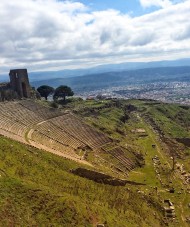
the many ruins at this sprawling site, you will have the opportunity to see the
incredible theater that is set into a steep hillside, the
famous library, the Temple of Trajan, the baths, the
acropolis and more. The Asclepion, where the famous medical researcher and
physician, Galen, studied is located a few kilometers south of the acropolis.
Though the impressive Zeus Altar has been removed to the Pergamon Museum in
Berlin, its foundations remain to be seen lying in the shade of large trees.
What remains of Pergamon is quite extensive and well presented.
After suitable perusing of the ruins at Pergamon, you will be returned
to your hotel.